What would it take for your city to keep thousands of pounds of food scraps out of the local landfill? For a growing number of Georgia cities, the answer isn't a new fleet of trucks or a big line item in the budget. It's a partnership.
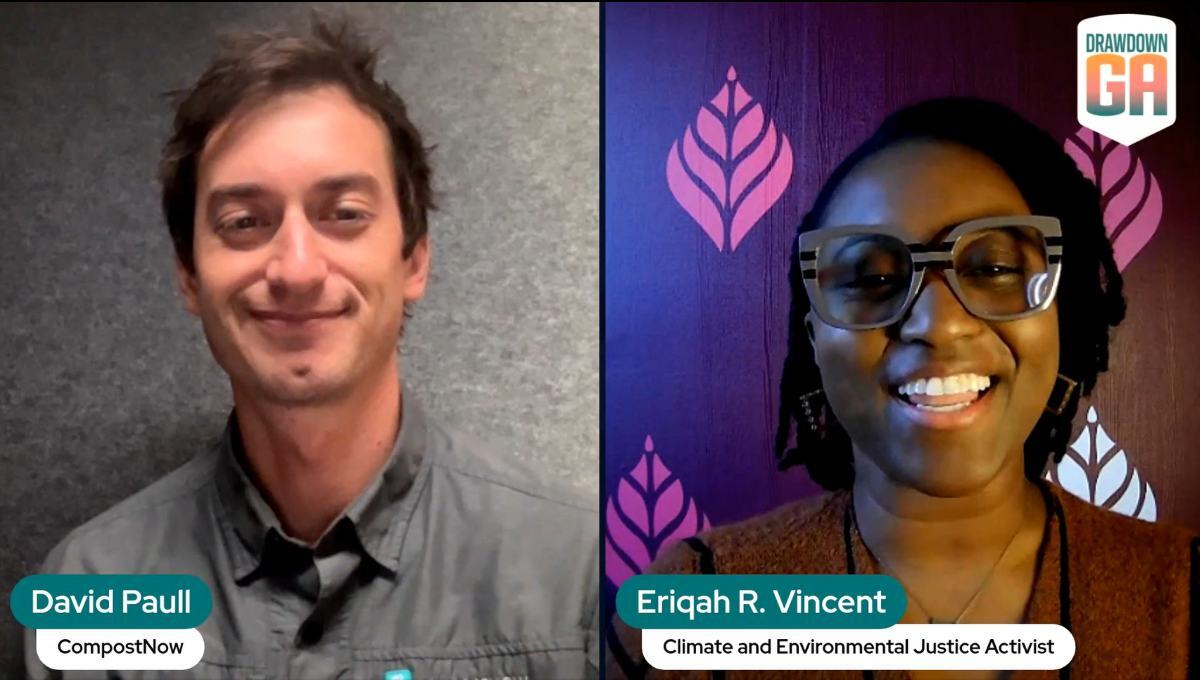
In our latest Georgia Climate Digest video interview, host Eriqah Vincent talks with David Paull, co-founder of CompostNow. David grew up surrounded by small family farms in rural Wisconsin and first connected food scraps to soil health while working on an urban farm on Atlanta's west side after he graduated from the Savannah College of Art and Design. Fifteen years ago, he helped start CompostNow as a small residential food scrap pickup service.
Today, CompostNow serves thousands of homes, businesses, and local governments across the Southeast and diverts about 1.5 million pounds of food scraps from landfills every month. In Georgia, it has partnered with Avondale Estates, Decatur, and Chamblee to bring curbside composting to residents, helping reduce food waste sent to landfills and returning finished compost to local farms and gardens.
Chapters
00:00 Welcome and Meet David Paull
01:25 From Wisconsin Farm Country to Composting
03:14 How CompostNow Works
05:05 Why Composting Is a Climate Solution for Georgia
08:07 Why Cities Are Partnering on Composting
13:14 Curbside Composting vs. Backyard Composting
15:51 What's Driving Momentum for Municipal Composting
18:37 What Needs to Change in Waste Management
21:20 Advice for Georgia Cities Ready to Start
23:26 How to Start a Conversation With CompostNow
25:08 What's Giving David Hope
Watch the video above to hear their full conversation, or keep reading for highlights on how municipal composting works in Georgia and how your city can get started.
Why Is Composting an Important Climate Solution for Georgia?
It comes down to what happens to food scraps in a landfill. Waste gets buried under more waste, which cuts off oxygen. Without oxygen, food breaks down and releases methane, a powerful greenhouse gas.
According to the U.S. Environmental Protection Agency, food makes up about 24% of the trash sent to municipal landfills but produces an estimated 58% of the methane those landfills release into the air.
For David, though, the most practical case for composting is that food scraps are a resource we've been throwing away. "If we could realize that we all had this material and could be connected to helping revitalize our agricultural soils and our soil health in general, then I think practically we would decide not to throw this away," he said.
That matters in a state where agriculture is a top industry. Keeping food scraps out of the landfill and turning them into healthy soil helps Georgia farms and Georgia's climate goals at the same time.
How Does Curbside Composting Work?
CompostNow started with a simple idea: lots of people want to compost, but not everyone has the space, time, or know-how to do it themselves. So the company built a service that works a lot like trash or recycling pickup.
Members collect food scraps in a bin at home. CompostNow picks them up and takes them to its own composting facility or a partner's site. There, the scraps break down through aerobic decomposition, meaning with plenty of oxygen, into finished compost.
"That finished compost product is teeming with nutrients. It's biologically active," David said. The last step closes the loop. Through CompostNow's garden partner program, members can get finished compost back or share it with local farms and gardens.
That model has grown well beyond homes. CompostNow's clients now include apartment buildings, restaurants, event centers, stadiums, hospitals, universities, food manufacturers, and local governments.
Why Are More Georgia Cities Turning to Municipal Composting?
David sees three things lining up at once.
-
More awareness. Ten or fifteen years ago, composting customers were mostly people already inclined to compost. Today, many cities have a sustainability officer, an environmental committee, or a Keep [City] Beautiful group that understands the value of composting.
-
Rising waste costs. David spends a lot of time at city council meetings and solid waste advisory meetings. "I hear pretty much the same thing from one meeting to the next, and that is that costs are rising, landfill space is a concern, and there's very little room or appetite to raise rates," he said.
-
Experienced service providers. Composting companies have matured. CompostNow now has nearly 90 full-time employees and its own fleet of vehicles. "We've figured this out," David said, adding “that just wasn't there even five years ago. I think we're hitting kind of that critical mass point."
How Can Cities Offer Curbside Composting Without Subsidizing It?
The biggest shift is in how programs are paid for. Through an opt-in public-private partnership, cities don't need budget for subsidies to get started. The city makes the service available, and residents who want it sign up and pay a reduced rate.
"Right now we're offering these services at $19 a month versus our doorstep subscription model where we started, which is about $40 a month," David said. That's roughly half the cost for residents.
Georgia cities have taken different paths to get there:
-
Avondale Estates ran a two-year curbside pilot funded by a U.S. Department of Agriculture grant that diverted more than 80,000 pounds of food waste.
-
Decatur began their city-operated pilot with about 100 households, and eventually moved to a citywide opt-in partnership in April 2026. CompostNow handles collection, processing, onboarding, and customer support, while the city handles outreach.
-
Chamblee approved its own opt-in curbside program this year, with service starting in October.
David expects this to grow. "Right now that's the opt-in model, but I think this is going to expand into subsidized models," he said.
Can Curbside Composting Work Alongside Backyard Composting?
Yes. CompostNow supports composting at any scale, including in your backyard. But curbside programs can take materials that are hard to break down at home, like meat, bones, dairy, some paper products, and compostable packaging. Commercial facilities reach higher temperatures, so more material breaks down.
There's also a bigger benefit for communities. When scraps stay in individual backyards, the nutrients rarely make it back to local farms. When a whole community takes part, finished compost flows back into the local food system at a much larger scale.
"All of a sudden you and your neighbors are participating in a collective nutrient cycling program," David said. "To do that effectively, you need scale."
What Needs to Change in Georgia's Waste Management System?
David's main point: start treating food scraps and other organic materials as a valuable resource, not just another type of trash.
He's quick to give today's waste system credit. "We don't need to vilify the current waste system or landfills," he said. "It's created clean communities." But it was built to dispose of material as cheaply as possible, and communities are now seeing its limits.
In David's view, a more circular system needs a few things:
-
Easier permitting for composting facilities, whether public or privately run
-
Economic incentives that reward keeping material out of landfills
-
Recognition of composting as local economic development, since facilities create jobs, support local farms, and produce a product that stays in the community
How Can Your City Start a Municipal Composting Program?
"I think people kind of let the perfect be the enemy of the good," David said. Many local leaders assume composting requires major investment in new trucks, equipment, and collection systems. With an experienced partner, it doesn't have to.
His advice is to start small. A first step can be as simple as a few food scrap drop-off stations around town. East Point, for example, partnered with CompostNow and Food Well Alliance to set up drop-off sites. From there, cities can expand to curbside service.
Whatever the starting point, education makes or breaks a program. Residents need to know why composting is valuable, how to do it, and what goes in the bin.
To get the ball rolling with CompostNow, any city stakeholder can reach out through the community services page on CompostNow's website. That could be a sustainability officer, a council member, or a resident who wants to champion the idea. "Where's the starting point? I think that's usually what's hardest for people to understand," David said. "We've worked that out, so we can help you through all of those steps."
What Is Giving David Paull Hope Around Climate in Georgia?
Right now, David's biggest source of hope is the wave of composting programs launching with cities. Part of what he loves about composting is how simple it is.
"All we're doing is taking this material that we all already have, and we're just saying, 'Instead of putting it in this bin, put it in this bin over here,'" he said.
That small change leads to a lot of good: less methane from landfills, local jobs, healthier soil, better food, and cleaner water. And for David, it fits Georgia well. "It's so tied into our agricultural heritage," he said. "It's tied into our ideas of being rooted in practical solutions and doing good by our communities and our neighbors."
Stay Connected to Conversations Like This One
Subscribe to the Georgia Climate Digest to get the latest good news on climate solutions in Georgia. You'll hear directly from local government leaders, business leaders, researchers, and community voices advancing solutions that work for our state, all sent to your inbox twice a month.