




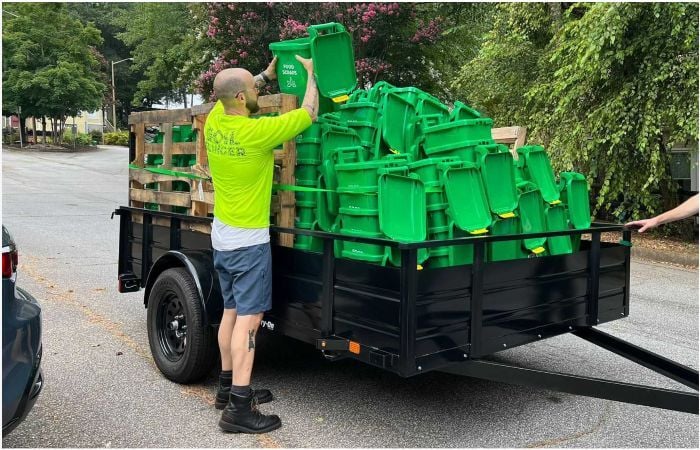
Could curbside composting work in your community?
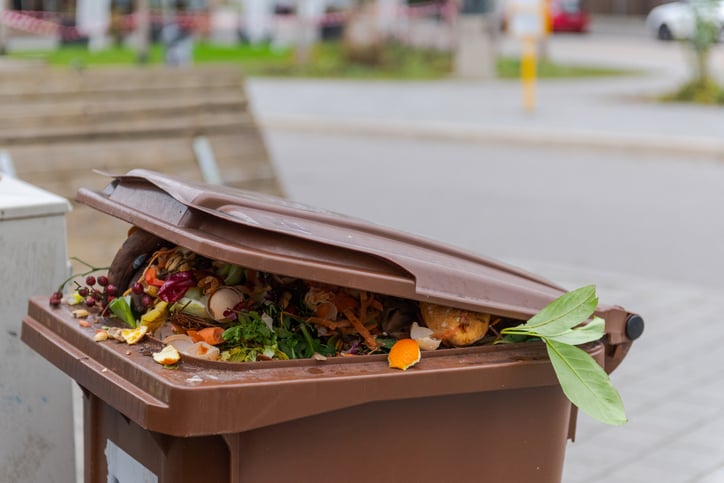
The City of Avondale Estates set out to answer that question through a pilot program that provided free compost pick-up for local households. The results were encouraging: more than 500 households enrolled, more than 80,000 pounds of food scraps were collected during the program's first eight months, and participant feedback was overwhelmingly positive.
Keep reading to learn more about how this pilot program came to be, and how the partners involved helped to make it a success.
Why Should Local Governments Support Composting Programs in Georgia?
Composting is one of the 20 Drawdown Georgia climate solutions because it helps reduce GHG greenhouse gas emissions while creating valuable products that support local agriculture, landscaping, and community green spaces. When food scraps and other organic materials are sent to landfills, they generate methane, a potent greenhouse gas. Composting keeps those materials in productive use and turns them into a resource that benefits communities across Georgia.
For local governments, composting can also provide an opportunity to reduce waste disposal costs, engage residents in sustainability initiatives, and strengthen local partnerships. While many communities are interested in expanding composting programs, questions often remain about participation rates, program design, costs, and long-term feasibility.
The City of Avondale Estates offers a useful example of how a small Georgia municipality tested those questions through a real-world pilot program. Working with CompostNow, DeKalb County Commissioner Ted Terry, Food Well Alliance, Roots Down, and with support from a USDA Composting and Food Waste Reduction grant, the city launched a free curbside food scraps collection pilot for residents.
The following case study from the Institute for Local Self-Reliance highlights how the pilot was structured, what participants thought about the program, lessons learned by project partners, and considerations for communities interested in exploring similar programs. For policymakers looking for practical, Georgia-based examples of climate solutions in action, Avondale Estates demonstrates how partnerships, community outreach, and existing composting infrastructure can come together to create a successful pilot program.
Keep Compost Local Case Study: Local Commissioner Drives Pilot Program with Multiple Partners
Public-Private Partnerships (PPPs)
The City of Avondale Estates is a small suburb (population ~3,500) in DeKalb County in the metropolitan Atlanta region. In 2024, the City was awarded $323,800 through a U.S. Department of Agriculture (USDA) Composting and Food Waste Reduction (CFWR) cooperative agreement to pilot free curbside food scraps collection from city households in partnership with CompostNow, DeKalb County Super District 6 Commissioner Ted Terry, Food Well Alliance, and Roots Down. The USDA grant funding is for two years and includes the 12-month curbside pilot program that covers service for up to 750 households. The City partnered with CompostNow, a subscription-based food scraps collection and composting company with operations in North Carolina, Georgia, and Ohio, to provide households with weekly collection using a 7-gallon food scraps bin. The initiative is CompostNow’s first municipal curbside pilot. The company was included in the USDA grant as a partner.
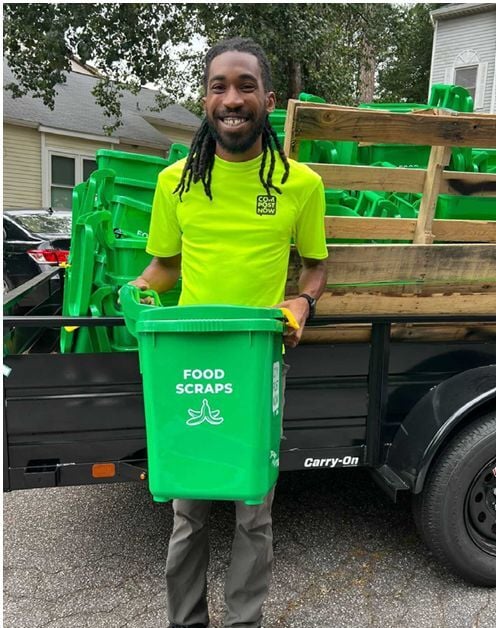 Photo Credit: CompostNow
In April 2025, the City was told that funding for the program was paused to “implement Administration priority alignment actions.” In turn, Avondale Estates paused the pilot after eight months of collection. In late July 2025, the City’s program passed USDA review, resulting in the reinstatement of funding. Collection resumed in August 2025 and ends in early December 2025.
Municipal Motivation and Pilot Logistics
DeKalb County Super District 6 Commissioner Ted Terry was interested in developing a viable curbside residential food scraps collection program that could be replicated in other municipalities in DeKalb County.
“Commissioner Terry approached the City of Avondale Estates to gauge its interest in partnering with his District office, CompostNow, and several other organizations to apply for the USDA CFWR grant,” says Miranda Rupkey. “We explained that the pilot would be turnkey and that the City didn’t need to do any legwork to set it up. The City had conducted a successful film plastic bag collection pilot using buckets distributed to households, and was amenable to trying a pilot focused on food scraps.”
A total of 534 households were participating in the pilot program when the USDA funding was suspended. Midway through the first eight months, it was decided to offer collection to multi-family households to reach the 750-participant goal of the pilot. Originally, service was limited to single-family dwellings. During the first eight months of the pilot, CompostNow collected and composted 80,243 pounds of food scraps. Accepted materials include a wide range of food scraps, BPI-certified compostable items, soiled paper and pizza boxes, household plants and soil, and pet food. Participating households enrolled in the pilot on CompostNow’s website and then received the 7-gallon curbside bin for their food scraps. CompostNow notified pilot participants that collection was restarting and delivered the 7-gallon bins that had been returned to the company when the pilot was suspended.
Composting Activity
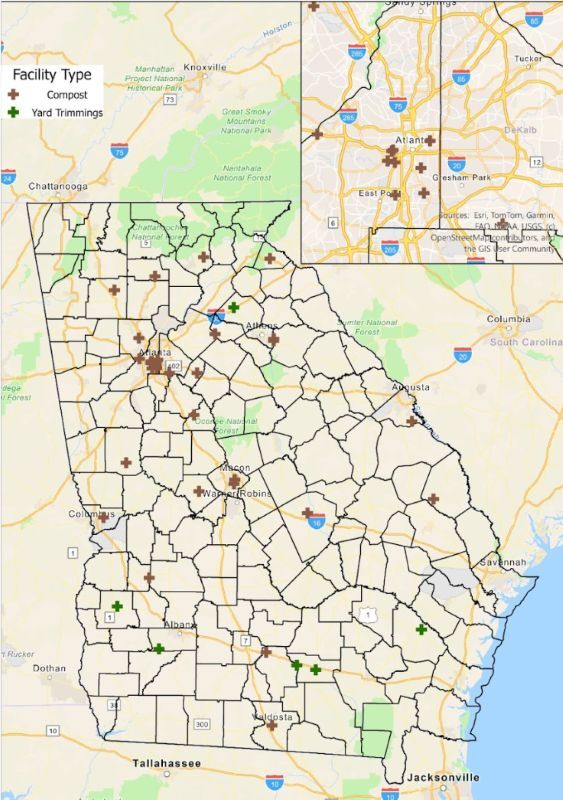
CompostNow hauls the food scraps it collects from Avondale Estates to its composting facility in Meriwether County, Georgia. It has a Georgia Environmental Protection Division Class II Permit By Rule composting permit, which enables the facility to take preconsumer and postconsumer food scraps.
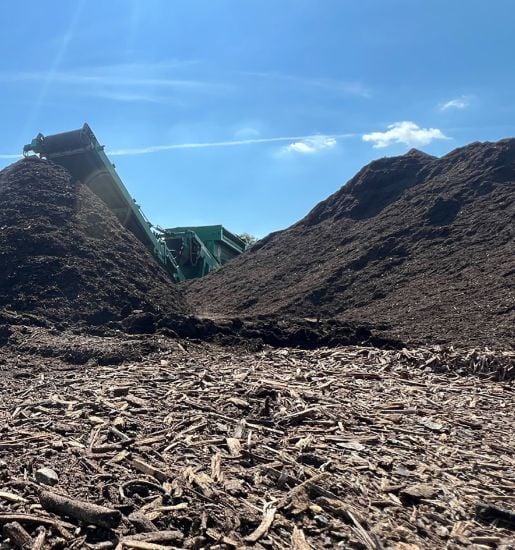
Photo Credit: CompostNow
Approximately 6,000 tons of feedstocks are processed annually, including collected organics from Avondale Estates. Finished compost from the Avondale Estates’ curbside pilot is distributed to DeKalb County growers by Food Well Alliance, and to local library gardens to support edible landscapes by Roots Down.
CompostNow has been working for the last decade to grow composting infrastructure in Georgia. On its website, the company notes that its advocacy for changing the zoning of its previous facility in Douglas County from Residential Agriculture to Agriculture was successful. “This was a massive victory for compost facilities and composting infrastructure in Douglas County and Metro Atlanta to allow for composting facilities to be an approved use under the more-protected agriculture umbrella, as opposed to heavy industrial,” explains CompostNow.
Outreach & Education
Both Avondale Estates and Commissioner Terry’s office conducted outreach and education to households prior to launch and during the pilot. Door-to-door marketing using door hangers, tabling at the farmers market, two mailings, social media, and articles in the City’s bimonthly newsletter were used. “When we expanded to apartment complexes, we held several open houses in building lobbies to publicize the pilot,” says Ellen Powell. “Our goal was to meet people where they are. Doing outreach and education fulfilled the City’s in-kind contribution to the USDA grant.” CompostNow supplements the City’s and County’s outreach via its webpage where households sign up to join the pilot. Instructions on the collection schedule and materials accepted, along with monthly impact reports (for all participating households combined), are provided.
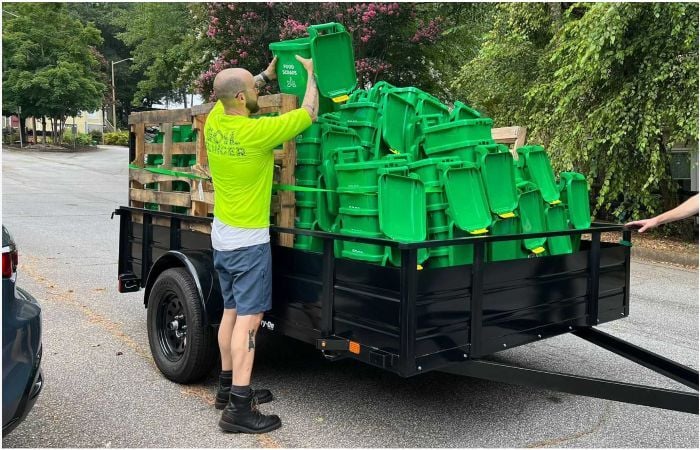 Photo Credit: CompostNow
Commissioner Terry’s office conducted a survey of participants to gauge their interest in and satisfaction with the pilot. “The response was overwhelmingly positive,” notes Rupkey. “About 30% of participants responded. One question asked if the pilot weren’t free, would they have participated? In their responses, 68 said maybe, 50 said no, 22 said yes (13.9%), and 18 said other. One person who said they would not have paid to join the pilot but has enjoyed diverting their food scraps so much that they would pay [for the service] when the pilot ended!”
The pilot did not originally include compostable liner bags and countertop bins for collecting food scraps in the kitchen. “We launched collection in August 2024 and by September, when the weather was still hot, some participants were saying that their curbside bins were messy and odorous, and attracting pests,” says Kate Emrich. “We worked with Biobag to give households countertop bins and liner bags, which helped resolve the situation. It was important that this pilot test the success and feasibility of a curbside tip model [bin is emptied and put back on the curb], as opposed to CompostNow’s standard doorstep clean swap [bin swap] subscription model. While the clean swap works for our subscription service, it’s not as scalable or economically feasible for most municipalities.”
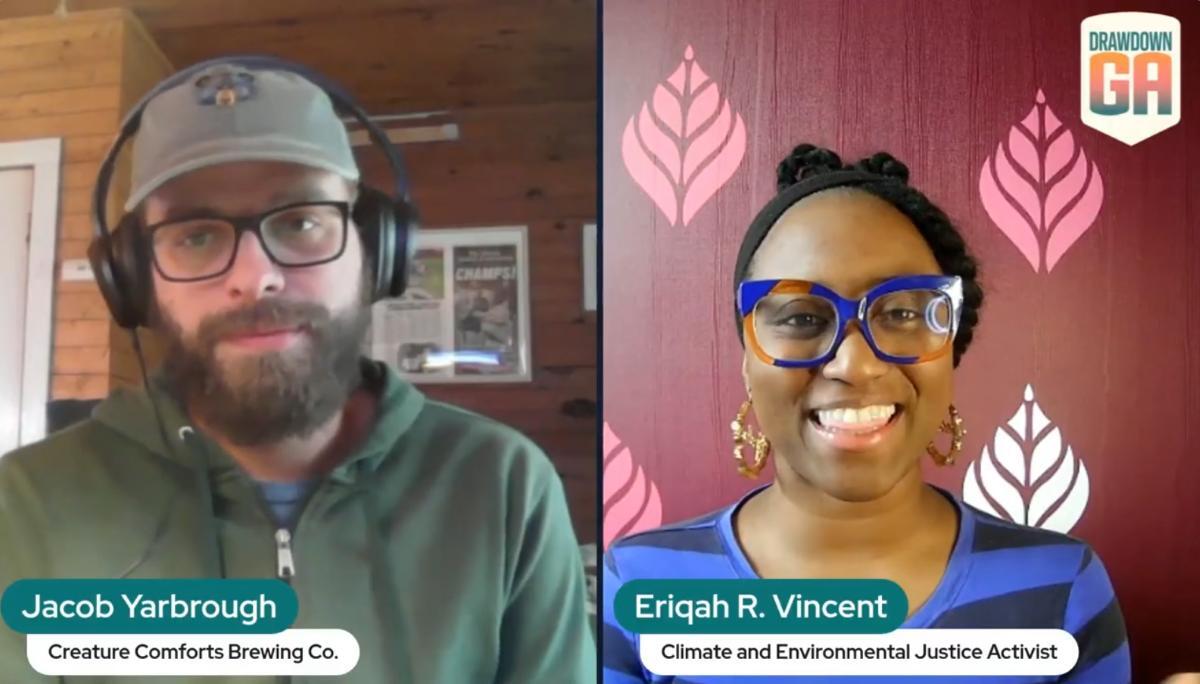
In July 2025, days before the City was notified that USDA had restored the funding, pilot partners participated in a webinar — open to the public — that was hosted by Commissioner Terry’s office. The webinar presented key takeaways and lessons learned from the residential food scraps collection program.
Costs & Benefits: Avondale Estates
The City benefited by receiving funding from the grant and support from Commissioner Terry’s office to make it possible to offer Avondale Estates’ residents an opportunity to divert their food scraps. When the grant funding was suspended, over 100 households decided to continue participating by subscribing to CompostNow’s collection service for $29 per month while the federal funding was frozen. In a July article about the pilot in the Decaturish, a local news site, Ellen Powell said the City would like to continue composting once the program is completed, but would need to “figure out the funding.” CompostNow’s David Paull noted in the article that “we provided numbers to the City of Avondale for what it would cost for CompostNow to continue to provide these services at a scaled, entire city level for Avondale, and that ended up being roughly about $100 a year per household.”
Costs & Benefits: CompostNow
The pilot has been beneficial from CompostNow’s perspective, providing an opportunity to learn and test what is involved with offering curbside collection in a municipal program. The company primarily works with municipalities under a memorandum of understanding to set up and service food scraps drop-off sites, which vary in scope from just carts and signs to more elaborate structures. “We’ve learned this curbside model works, but having sustained funding is key,” says Emrich. “The biggest barrier we’re finding and where these pilot programs are getting hung up is figuring out a way to fund them long term.”
Public Private Partnership Lessons Learned
City of Avondale Estates: The City of Avondale believes providing residents with curbside collection of food scraps is “possible and feasible” and that the current pilot has been effective in bringing awareness to the value of food scraps recycling and compost. “Proof of that is the number of pilot participants that continued the service after the suspension, even though they had to pay,” says Shannon Powell. “Our partnership with CompostNow has been successful. They are pros and were very efficient in getting the program up and operating smoothly. This speaks to partnering with an existing service provider that has learned what it takes to make this type of service successful.”
CompostNow: CompostNow has learned through the City of Avondale pilot, as well as its municipal food scraps dropoff partnerships, that “spelling out what the individual roles for the parties involved are going to be and who holds what responsibilities during the program are critical,” notes Paull. “For us, this has been a necessary point of improvement. On paper, CompostNow is just a collector of material. In reality, much more is involved, e.g., fielding questions from households when our crews are servicing the routes, even though the allocated budget does not include outreach and education. It is also very important, during negotiations with municipalities — especially with pilots — to be clear about what they want to establish and what they are trying to accomplish. This lays the groundwork for successful programs.”
He adds that public-private partnerships to deliver municipal programming will be a critical part of the composting industry’s future. “Local composters are uniquely positioned to be program partners,” Paull emphasized.
Subscribe to Stay Up to Date
Make sure you always have the latest news and stories from the Georgia climate community by subscribing to the Georgia Climate Digest.
You'll receive interviews, updates on Georgia’s progress on climate solutions, news from across the state, and actionable insights on climate delivered straight to your inbox twice a month.

Source: J. Spector, N. Goldstein, B. Platt, S. Jones, Keep Compost Local: A Roadmap for Local Government to Build Community Prosperity with Composting, Institute for Local Self-Reliance, 2026 (https://ilsr.org/articles/composting-for-community/keep-compost-local-report). Reprinted with permission.