





For policymakers, advocates, and community leaders working to scale climate solutions, the hardest part is often knowing where to start.
In this case study, we explore how county-level data in the Drawdown Georgia Solutions Tracker can help pinpoint opportunities to scale climate solutions. Specifically we look at communities where electric heating is widespread, but heat pump adoption remains low.
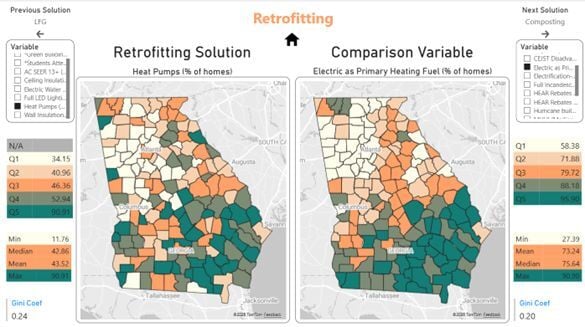
Using data collected in the Drawdown Georgia Solutions Tracker, we see that these counties may offer some of the state's best opportunities to improve energy efficiency. Read on to see how the Solutions Tracker can identify these opportunities and to learn more about the benefits of heat pumps for Georgia residents.
How Can the Solutions Tracker Identify Electrification-Ready Communities in Georgia?
Much of the county-level data behind this post comes from the Solutions Tracker, a product of the Drawdown Georgia research team, which has been localizing global climate solutions for Georgia since 2018. The Tracker shines a light on places where solutions are already common, and where the benefits of adoption are strong. It pinpoints where opportunities and enablers are concentrated, without waiting on a statewide study.
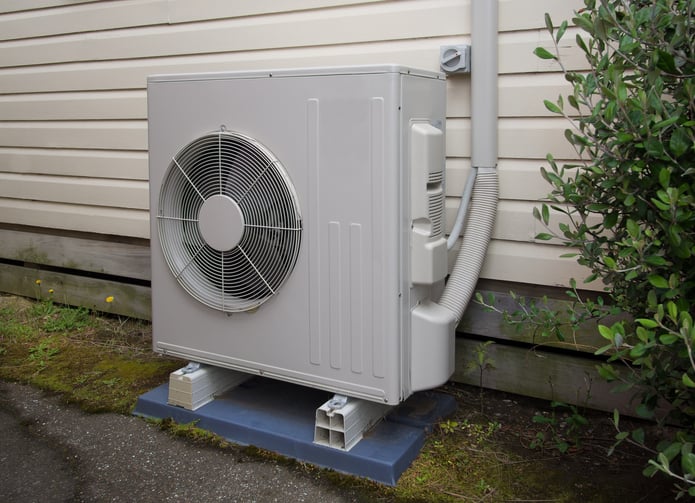
Heat pumps vs. electric heating fuel as % of homes
Source: Drawdown Georgia’s Solutions Tracker
On the left side of the Retrofitting screen of the Tracker, we select Heat Pumps from the solution variables, then choose Primary Heating Fuel as the comparison variable on the right. Placing the two maps side by side highlights where electric heating is common, but heat pumps are not. For most households in those counties, adopting heat pumps would not require switching from natural gas to electric heat but would involve replacing inefficient electric resistance heating with a heat pump.
Southeast Georgia Has High Rates of Heat Pump Adoption, but Exceptions Exist
This comparison reveals a clear pattern in rural Southeast Georgia: many counties have high rates of electric heating paired with high rates of heat pump adoption. But three adjacent counties illustrate exceptions: about 90% of households in Montgomery, Toombs, and Jeff Davis Counties have electric heating but only 37-45% have heat pumps. Converting more homes in those counties to heat pumps represents a promising opportunity to scale this climate solution.
North Georgia Has Higher Rates of Heat Pump Adoption than One Might Expect
Northern counties in the Blue Ridge Mountains show a different pattern. Fannin, Union, Towns, and Rabun are in the bottom two quintiles for reliance on electricity as the primary heating fuel, with natural gas and propane playing larger roles, yet heat pump penetration is significant (at 36-42%). This pattern may reflect both the value of supplemental or dual heating in colder climates and the realities of rural energy infrastructure, where access to natural-gas distribution lines can be limited. Although the Georgia Public Service Commission notes that natural-gas service is certified in about 90% of Georgia counties (through Atlanta Gas Light, Liberty Utilities, and 84 municipal gas systems), certification doesn’t mean gas lines reach every home.
This type of county-by-county analysis is exactly what the Solutions Tracker was built for. With climate science predictions occurring sooner than expected, local data can help identify early movers, encourage “peer-suasion,” and turn statewide goals into actionable community insights.
>>Explore the Drawdown Georgia Solutions Tracker to see how heat pump adoption and other Drawdown Georgia climate solutions look in your own county.
How Did Heat Pumps Get So Efficient?
Georgia's shift toward electric heating has been building for decades, but the rapid growth of heat pumps specifically is a newer story rooted in years of research.
Heat pumps first entered the mainstream market in Europe in the late 1970s before slowly expanding across the U.S. and the rest of the world (Nyborg & Røpke, 2015). Scientists at Oak Ridge National Laboratory in Tennessee played a pivotal role over multiple decades in bringing today's modern, high-efficiency, and affordable heat pumps to the U.S. marketplace. Their contributions include research on refrigerants, techniques to reduce the cost of heat exchangers, improved mechanical designs to enable better air handling systems, and sensors and controls to promote reliability and interoperability (Brown, et al., 2024). Numerous Georgia-based business and industry partnerships were keys to this success, including ASHRAE and Rheem, which have a strong presence in Atlanta and are helping to multiply this climate solution in Georgia.
What Is a Heat Pump and How Is It Different from a Furnace?
Heat pumps are highly energy-efficient because they transfer heat rather than generate it directly. In summer, they move heat from indoors to outdoors; in winter, they reverse the process and move heat indoors. Unlike gas furnaces or electric-resistance heaters, heat pumps do not create heat by burning fuel or passing electricity through resistance elements.
As a result, heat pumps deliver two to four units of heat for every unit of electricity consumed, substantially reducing household energy consumption and bills. Under many conditions, they also have lower operating costs compared to natural gas furnaces (U.S. Department of Energy, 2024; International Energy Agency, 2022). Because a heat pump provides both heating and cooling, it can replace separate heating and air-conditioning equipment. Ductless mini-split heat pumps can also serve homes without central ductwork, using indoor units or “heads” to heat and cool individual zones. Cold-climate heat pumps have further expanded the technology's usefulness during North Georgia winters.
How Much Could a Heat Pump Save Georgia Homeowners?
The exact savings for any one household depend on the system being replaced, local electricity rates, and how well the home is insulated, but national data offer a useful benchmark. The U.S. Department of Energy reports that homes heating with electricity, including heat pumps, spend significantly less over a winter than homes heating with propane or heating oil, citing EIA data showing typical annual bill savings of a few hundred dollars for many households, rising to roughly $1,000 a year or more for homes switching away from propane, oil, or older electric-resistance heat.
A 2024 study from the National Laboratory of the Rockies published in the journal Joule found that 62% to 95% of U.S. households would see lower energy bills after switching to an air-source heat pump, and that share climbs to 82% to 97% when the switch is paired with basic weatherization such as sealing and insulation. Georgia's mild winters and long cooling season tend to work in a heat pump's favor, since the technology performs best when it isn't fighting extreme cold for months at a time.
Installed costs vary widely by system type, home size, and existing infrastructure. Rewiring America's national cost model, based on real project data and adjusted for inflation and regional labor costs, estimates $17,000 to $23,000 for a whole-home ducted heat pump in a typical 1,500- to 2,500-square-foot home, rising to $22,500 to $28,000 for larger homes. A single-zone ductless mini-split, often a better fit for homes without existing ductwork, typically runs $5,400 to $8,500.
Rewiring America also estimates that households switching from electric baseboards, an electric furnace, fuel oil, or propane save about $900 a year on average, which puts the simple payback period for a mini-split around 7 years, while a full whole-home ducted system takes considerably longer to pay for itself. Georgia's moderate climate and generally smaller heating loads may place many homes toward the lower end of national cost ranges, but a contractor's on-site quote is the only way to know for sure.
A more useful payback benchmark looks at the incremental cost of choosing a heat pump over the air conditioner a home would need to replace anyway, rather than the full installed price. Using this approach, the American Council for an Energy-Efficient Economy found a median simple payback of 4.7 years for homes that already have central air conditioning and are switching from electric resistance heat. This may be the largest single opportunity for heat pump conversions in Georgia. For homes without existing central air, where a heat pump has to cover the cost of a full heating and cooling distribution system, the median payback stretches to nearly 15 years.
What Rebates and Tax Credits Are Available for Georgia Homeowners?
Financial assistance has significantly improved the economics of buying a heat pump. Installation costs are typically higher than those of conventional heating and cooling systems. However, many regional and statewide rebate programs can go a long way to help offset these costs.
The GA Environmental Finance Authority (GEFA) offers the Home Efficiency Rebates (HER) program, which provides rebates for whole-home energy-efficiency retrofits based on household income and the energy savings a project achieves. A heat pump can help a household qualify for an HER rebate, but installing one alone typically isn't enough. A heat pump would need to be paired with additional efficiency improvements, such as insulation or air sealing, to reach HER's minimum threshold of a 20% whole-home energy savings.
Many energy providers also offer rebates on heat pumps that can be stacked with HER rebates. For example, Georgia Power offers its own rebate of up to $1,500 for a qualifying air-source heat pump conversion. Many EMCs across the state also offer similar rebates to customers.
Until recently, GEFA also offered the Home Electrification and Appliance Rebates (HEAR) program, which provided point-of-sale rebates for low- and moderate-income households purchasing ENERGY STAR-qualified appliances, including heat pumps. As of August 2026, GEFA has paused new HEAR submissions while the program works through a backlog of applications; the agency has not announced when, or whether, it will reopen to new applicants. Homeowners should always check whether any state or local programs have changed, since available incentives can shift.
>>Learn more about rebates available for upgrading to a heat pump in your home.
How Many Georgia Homes Already Have a Heat Pump?
According to the 2024 American Community Survey (ACS), electricity is the primary heating fuel for 57% of Georgia households. Heat pumps are the fastest-growing type of heating equipment in the state, and 33% of Georgia households have at least one. (The tracker shows a larger “unweighted” mean of 44%, which reflects higher penetration in smaller rural counties.) According to the 2020 Residential Energy Consumption Survey, electric-resistance heat (central furnace, baseboards, or wall units) is the principal heating equipment for an estimated 24% of Georgia households.
Put another way, nearly half of Georgia's electrically heated homes still rely on older, less efficient electric-resistance systems rather than heat pumps. These households are paying more than necessary on heating. Yet replacing a working system is a hard sell when upfront costs are high, the payoff comes later, and households may be unsure how much a heat pump could lower their energy bills.
Is My Home Ready for a Heat Pump?
One potential barrier to residential heat pump adoption is the limited capacity of a home's electrical circuit-breaker panel. Older homes often have 100- or 150-amp service rather than the 200-amp service. Their panels may not have the capacity or physical space for additional loads, particularly if the system includes electric-resistance backup heat strips. If a licensed electrician's load calculation indicates that the existing service cannot safely accommodate the new equipment, installation may require a panel or service upgrade, adding thousands of dollars and requiring coordination with the electric utility and local code officials.
On the other hand, a 200-amp service is not always necessary. Modern variable-speed heat pumps can be more efficient than the resistance heating they replace, which sometimes lowers a home's total electrical load rather than adding to it, avoiding a costly upgrade altogether. The capacity, condition, and available space in the existing panel is often the biggest single factor in what a heat pump installation ends up costing.
Statewide, about 58% of Georgia homes are considered “electrification-ready,” meaning they already have the breaker panel amperage needed for heat pumps according to the Drawdown Georgia Solutions Tracker. (The tracker shows a higher “unweighted” mean of 68%, which gives too much weight to the penetration of newer circuit breaker boxes in younger suburban and rural counties.) Homes in suburban and rural Georgia are more likely to be ready, while homes in the historic cores of Georgia's larger cities – often built before modern electric loads were common – are less likely to qualify without an upgrade.
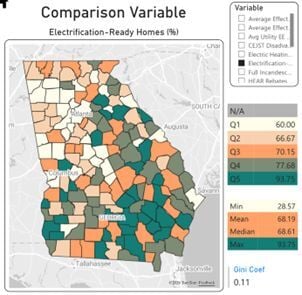
Electrification-ready homes by county
Source: Drawdown Georgia’s Solutions Tracker
What's Next for Heat Pumps in Georgia?
Understanding the drivers behind heat pump adoption could provide valuable insights for policies and programs designed to accelerate heat pump deployment across Georgia. Some organizations are already providing analysis and assessment services, including BlocPower, which serves electric heating and cooling needs for older buildings in low-income areas. Census tract levels could help these efforts assess heat-pump compatibility in low-income homes, given fuel use, ducting, and breaker-box readiness.
Adoption of any new technology follows a predictable path: awareness, forming an opinion, deciding, acting, and then confirming the choice was the right one. People tend to adopt technologies that feel familiar and don't require a dramatic break from what they already know. That's why early adopters matter: when neighbors, colleagues, and community leaders make the switch and talk about it, they help others feel confident doing the same (Kale and Brown, 2025; Cha et al., 2024; Brown et al., 2023).
Heat pumps are well suited to Georgia. The technology is mature, potential savings can be substantial, and incentives are stronger than in recent years. The larger question is how quickly Georgia households will make the switch, given that roughly half of electrically heated homes still rely on older resistance-heating systems.
The opportunity for heat pumps to cut household electricity bills is already significant. Adding a voluntary direct-control “demand response” program in the future (another Drawdown Georgia solution) could provide additional household savings. Recent breakthroughs by the Building Technologies Research and Integration Center at Oak Ridge National Lab could soon deliver better cold-climate and dual-fuel heat pumps that could expand load shifting for grid-interactive heat pumps.
Together, these advances could make heat pumps more than an efficient replacement for conventional heating and cooling equipment. They could lower household energy costs, provide new opportunities for customers to earn compensation through demand-response programs, and help Georgia utilities manage peak electricity demand and integrate a growing share of renewable generation.
Explore Local Opportunities to Scale Climate Solutions Now
Are you curious what heat pump adoption, electrification readiness, or any of Georgia's other climate solutions look like in your own county? Explore the Drawdown Georgia Solutions Tracker now and dive into the data for yourself.


.png)